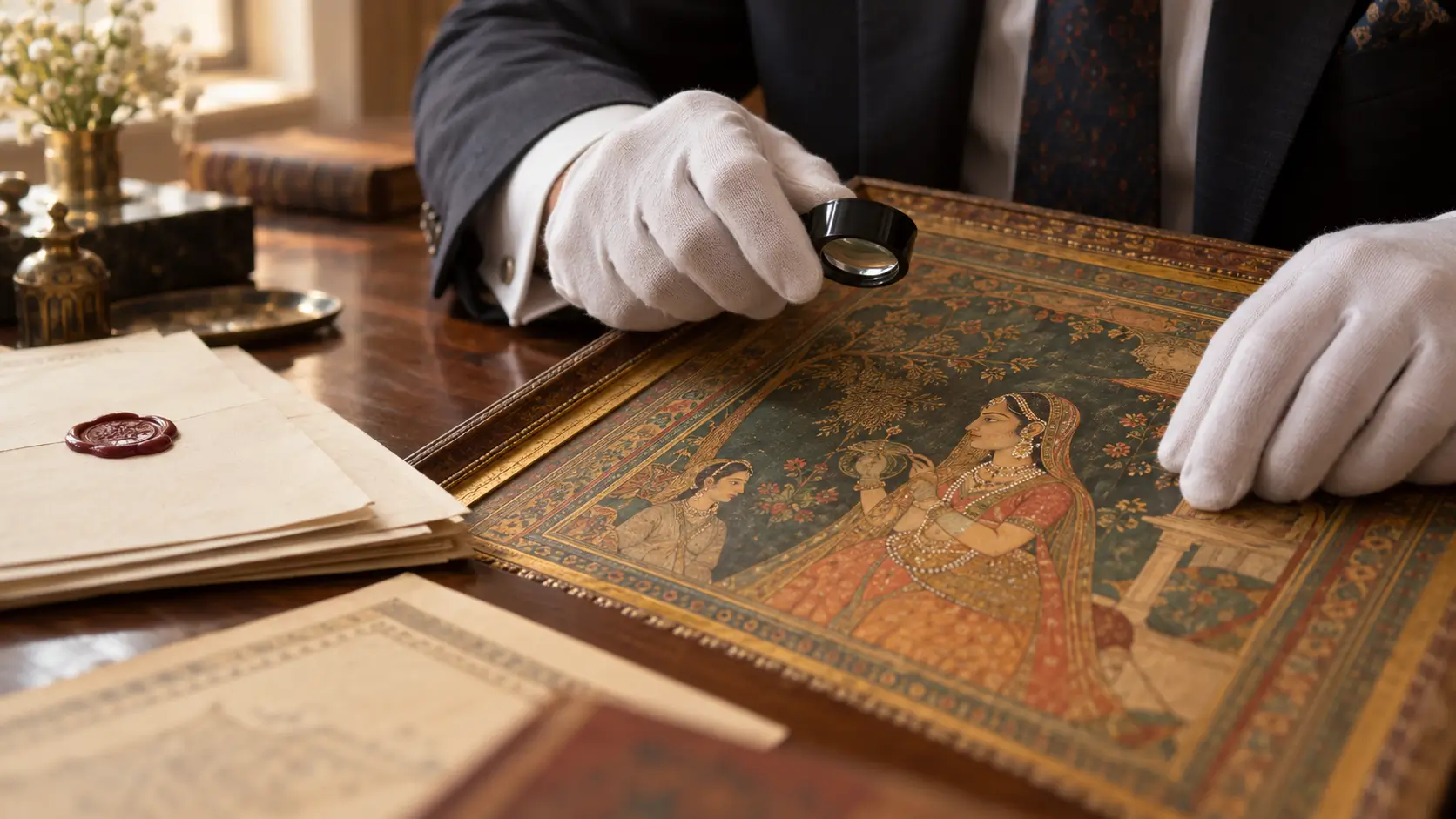


When people think about art insurance, they often focus on whether a collection is insured or not. But for valuable artworks, antiques, artefacts, sculptures, and collectibles, the more important question is often this:
Is the collection insured at the right value?
An artwork may be included in an insurance policy, but if its declared value is inaccurate, the protection may not be adequate. If the value is too low, the client may be exposed at the time of loss. If the value is too high, the client may pay unnecessary premiums and still face questions if the declared amount is not supported by proper valuation documentation.
This is the problem of underinsurance and overinsurance. For high-value art collections, both can create avoidable risk.
A professional, expert-led art valuation supported by better benchmarking can help reduce this risk before a policy is issued, renewed, or reviewed.
What Is Underinsurance in an Art Collection?
Underinsurance happens when an artwork or collection is insured for less than its current appropriate value.
This can happen for several reasons. The artwork may have been purchased many years ago and insured at the original purchase price. The artist’s market may have changed significantly. The work may have gained importance because of exhibitions, publications, auction movement, or increased collector demand. The collection may have grown over time, but the insurance schedule may not have been updated. Inherited or gifted works may have been added to the household or corporate collection without a formal valuation.
In such cases, the insured value may no longer reflect the current market or insurance context.
For the client, underinsurance can become a serious issue when there is damage, theft, loss, fire, flooding, transit damage, or another insured event. The client may believe the collection is protected, but the declared value may not support the actual value of the asset.
For insurance brokers and risk advisors, underinsurance can also create reputational risk. A client may only discover the gap when it is too late.
What Is Overinsurance in an Art Collection?
Overinsurance is the opposite problem. It happens when an artwork or collection is insured at a value higher than what can be reasonably supported.
This may occur when clients rely on emotional value, informal estimates, outdated advice, exaggerated market assumptions, or unverified online references. Sometimes collectors assume that because an artist is well-known, every work by that artist has the same level of value. But art valuation is rarely that simple.
Two works by the same artist can have very different values depending on medium, size, period, subject matter, condition, provenance, rarity, and market demand. A large canvas may not always be more valuable than a smaller but historically significant work. A work from an important phase of an artist’s career may command more attention than another work from a less sought-after period.
Overinsurance can lead to unnecessarily high premiums. It can also create difficulty if the declared value is challenged during review or claim assessment. A high declared value without a strong valuation basis is not the same as a defensible valuation.
Why Art Is Difficult to Value Accurately
Art is unlike many other insured assets. It does not follow a simple depreciation schedule. Its value cannot be determined only by material cost, age, or purchase invoice. In some cases, the value of an artwork may rise substantially over time. In others, it may remain stable or even decline depending on market interest, condition, authenticity concerns, or changes in collector demand.
A credible art valuation considers several factors, including:
- Artist and market relevance
- Medium and dimensions
- Subject matter and visual importance
- Period or year of creation, where available
- Rarity and availability of comparable works
- Provenance and ownership history
- Condition and conservation status
- Market movement and comparable references
- Purpose of valuation, such as insurance, tax, estate, sale, or corporate documentation
Because of these variables, a generic estimate is not enough. Art requires specialist interpretation.
This is especially important for insurance, where the declared value becomes part of the risk conversation between the client, broker, and insurer.
Why Benchmarking Matters
Benchmarking is the process of comparing a valuation against relevant market signals and comparable references. In art valuation, this is not a mechanical comparison. It requires judgment because no two artworks are exactly the same.
For example, an artwork may be similar to another work by the same artist in size or medium, but differ significantly in period, subject matter, provenance, or condition. A comparable reference is useful only when it is interpreted correctly.
Better benchmarking helps reduce both underinsurance and overinsurance because it provides a wider context for valuation. It helps experts assess whether a value is reasonable, defensible, and aligned with the asset’s characteristics and market context.
For insurance brokers, this can strengthen advisory conversations with clients. For insurers, it can improve clarity around declared values. For collectors and corporates, it can help ensure that their collection is neither undervalued nor inflated without basis.
How AI-Augmented Benchmarking Strengthens Expert Valuation
AI-augmented benchmarking adds a new layer of support to the valuation process. However, it is important to understand what this means.
It does not mean that AI decides the value of the artwork. It does not mean that a valuation is automatically generated. It does not replace expert judgment.
Instead, an AI-augmented benchmarking layer supports the expert valuation by cross-verifying relevant parameters against publicly available global market data and wider art-market intelligence.
At TurmericEarth, every valuation begins with human expertise. The assessment is first developed through a proprietary internal valuation process built over 25+ years. This process is supported by 30,000+ proprietary artwork records, including artist, medium, dimensions, subject matter, period/year where available, and other valuation-relevant parameters.
The valuation is then strengthened through an internally built AI-augmented benchmarking model. This helps cross-check the expert assessment against broader market intelligence and comparable signals. The final valuation remains expert-led, expert-reviewed, and certified by TurmericEarth.
For insurance purposes, this approach is valuable because it combines three important layers:
Human expertise to interpret the artwork.
Proprietary valuation experience built over decades.
AI-augmented benchmarking to support wider market validation.
How This Helps Reduce Declared Value Risk
Declared value risk occurs when the value mentioned for insurance purposes is not well supported. This may expose the client to inadequate coverage, excessive premiums, or uncertainty during review.
Expert-led, AI-augmented valuation helps reduce this risk in several ways.
First, it brings structure to the assessment. The artwork is evaluated through a specialist process rather than informal estimation.
Second, it adds data depth. The valuation is supported by TurmericEarth’s proprietary records built over 25+ years.
Third, it introduces broader benchmarking. The AI-augmented layer helps cross-verify relevant factors against publicly available global market data and wider market intelligence.
Fourth, it preserves human judgment. The final valuation is not delegated to technology. It is reviewed and certified by valuation experts.
This is particularly important because art value includes both objective and subjective elements. Medium, dimensions, artist, and year may be recorded as data points, but rarity, subject matter, importance, and market relevance require trained interpretation.
When Should Art Collections Be Revalued for Insurance?
Underinsurance and overinsurance often happen because valuation records become outdated. For clients with valuable art collections, periodic revaluation is an important risk management practice.
A collection should be reviewed when:
- A new insurance policy is being issued
- An existing policy is being renewed after several years
- New artworks, antiques, or collectibles are added
- Works are moved, stored, loaned, exhibited, or transported
- A corporate collection is being audited or relocated
- A family collection is being divided, inherited, or documented
- Market movement affects an artist or category
- Restoration, damage, or condition changes occur
For brokers, these moments are opportunities to advise clients responsibly and proactively.
Why This Matters for Brokers, Insurers, and Clients
Accurate valuation benefits all stakeholders in the insurance process.
For clients, it improves confidence that the collection is protected at a more appropriate value.
For brokers, it strengthens the quality of advisory and helps reduce ambiguity in client conversations.
For insurers, it provides a clearer basis for underwriting, documentation, and future claim-related assessment.
For corporates and family offices, it supports better asset records and internal governance.
In short, valuation is not just a pre-insurance formality. It is a risk management tool.
The TurmericEarth Advantage
TurmericEarth is India’s pioneering art valuation company and offers India’s first expert-led, AI-augmented art valuation service.
Built on 25+ years of specialist experience, TurmericEarth’s valuation practice combines human expertise, a proprietary internal valuation process, 30,000+ artwork records, and an internally built AI-augmented benchmarking model.
Across 25+ years of work with insurers, institutions, corporates, government bodies, HNIs, and private collectors, TurmericEarth’s valuation reports have been trusted and have stood without dispute.
For insurance brokers, insurers, and clients with valuable collections, this offers a more credible and carefully reviewed approach to declared value accuracy.
Conclusion
Underinsurance and overinsurance are both avoidable risks. One can leave the client exposed. The other can result in unnecessary premium costs and unsupported declared values.
The solution is not guesswork, informal estimation, or an automated valuation. It is expert-led valuation supported by data depth and intelligent benchmarking.
AI-augmented art valuation helps strengthen the process by giving experts a wider frame of reference while keeping the final judgment in human hands.
For clients who own valuable artworks, antiques, artefacts, sculptures, or collectibles, better valuation benchmarking can make insurance protection more accurate, credible, and defensible.
To learn more, explore TurmericEarth’s expert-led art valuation services.